






THE OPPORTUNITY
AI is already here.
Productivity is accelerating. Governance must keep pace.
SOTERIA CLOUD PRESENTS
Acronis
GenAI Protection
Protect every prompt. Govern every interaction.
Headphones recommended · 2 min 04 sec
Your people are already using AI
Evidence and enforceable controls — not assumptions or blanket bans
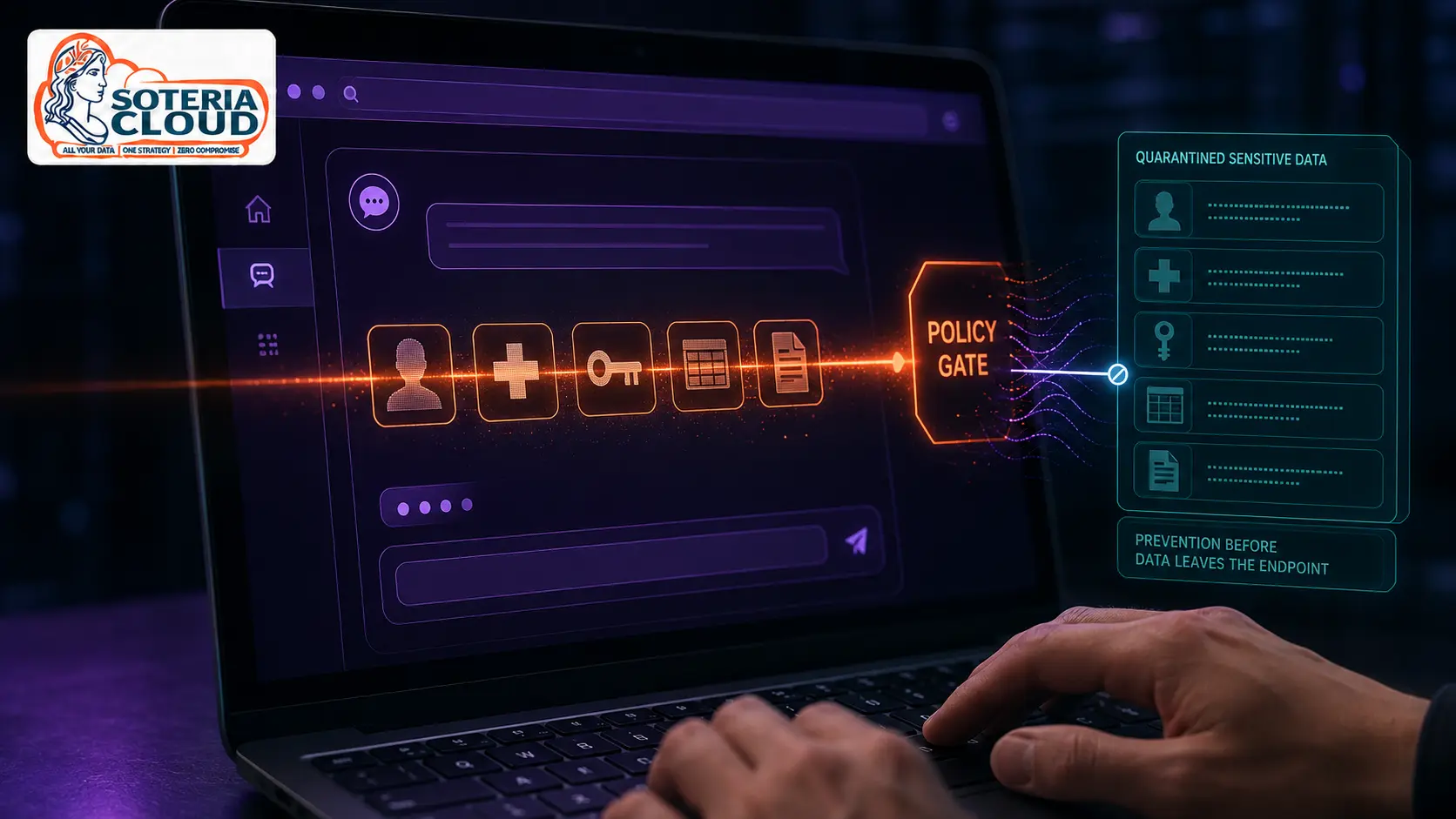
Generative AI can improve research, drafting, analysis and automation. It can also create risk when users adopt consumer-grade tools outside IT oversight or paste sensitive business information into external services. A safe-AI programme needs evidence and enforceable controls.
Four controls for safer AI adoption
A layered model for GenAI governance
Discover Shadow AI
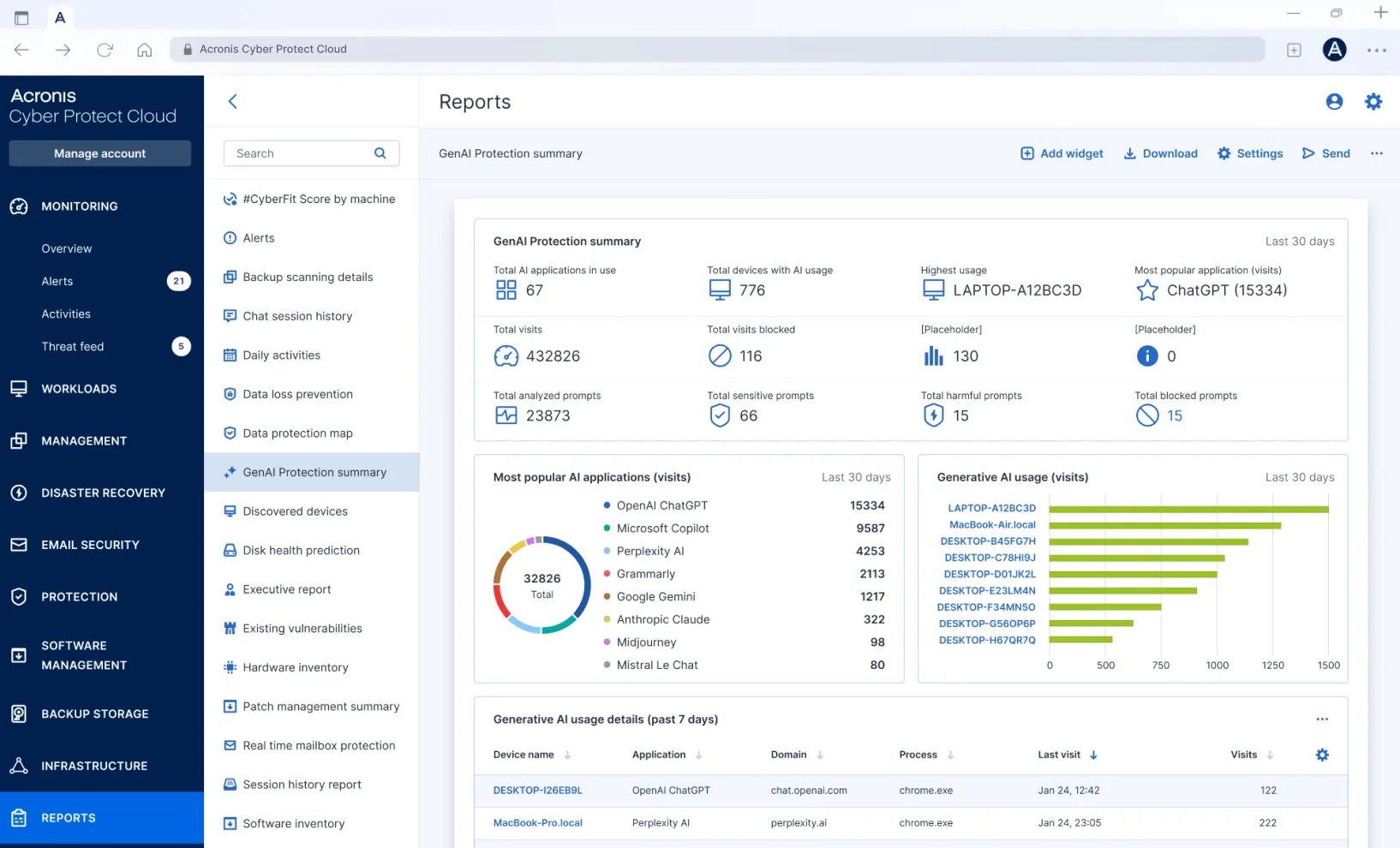
Monitor browser-based GenAI tools across protected environments. See which services are being used, by whom and how often, then use trends and events to guide policy.
Protect sensitive prompt data
Inspect prompts for categories such as personally identifiable information, health information, payment-card-related data, credentials and confidential business content. Block unauthorised submission before it reaches a public or unsanctioned AI service.
Stop harmful prompts
Detect and block prompt injection and other malicious or policy-violating prompts that could manipulate AI behaviour, bypass controls or introduce unsafe content.
Govern application access
Use allow-only or block-only policies for GenAI applications and domains. Attribute events to logged-in users and support investigations with central events, widgets and reports.

One central view
Bring unmanaged AI usage into the light
Distributed AI usage across client environments becomes visible in one central governance view — the evidence you need to guide policy before you enforce it.
From observation to enforcement
Move at the pace of evidence
Observe
Run detect-only mode and understand actual usage before imposing assumptions.
Decide
Approve tools, purposes, data categories, owners and exception paths.
Enforce
Activate proportionate prompt DLP, harmful-prompt and application controls.
Improve
Review evidence, tune controls, coach teams and extend broader DLP where required.
What the service can monitor and control
Capability to business outcome
| Capability | Business outcome |
|---|---|
| Shadow AI monitoring | Understand adoption and expose unmanaged tools |
| Sensitive-data classification | Reduce the risk of personal, regulated or confidential data entering external AI services |
| Prompt DLP | Block unauthorised data submissions at the point of interaction |
| Harmful-prompt protection | Reduce prompt-injection and AI-abuse exposure |
| Application access control | Align AI tool use to the approved application list |
| User attribution and reporting | Support investigation, accountability and service review |

Evidence, widgets and reports
Central visibility your reviews can act on
Important scope boundary
GenAI Protection focuses on browser-based GenAI interactions. Acronis positions its broader DLP service for protection across additional local and network channels, including local GenAI applications. Soteria Cloud will help define the coverage and package clearly.
POPIA-aware AI governance
Technical controls can support accountability, processing limitation and security-safeguard objectives when they are paired with an approved-use standard, business ownership, user communication, incident handling and appropriate contracts. GenAI Protection does not automatically establish POPIA compliance or replace legal advice.
A managed service, not a one-time switch
Enablement across the whole lifecycle
A Soteria-enabled partner service can include the full path from discovery to executive reporting.
Ask AB about GenAI Protection- AI usage discovery and baseline reporting.
- Approved application and domain policy design.
- Sensitive-data and harmful-prompt control configuration.
- Exception handling, incident review and policy tuning.
- Executive reporting and safe-use enablement.
AI data leakage · Practical business guide
What happens when a useful prompt contains sensitive data?
Follow an illustrative South African business scenario. Separate application blocking from prompt inspection, understand POPIA considerations and plan a four-week pilot that produces useful evidence.
Downloadable resources
Take the detail with you
AI Data Leakage Case Study
An illustrative South African scenario, proposed pilot and evidence criteria — not measured customer results.
Download PDFData Sheet
Technical capabilities and control model at a glance.
Download PDFBrochure
High-level overview of GenAI Protection and positioning.
Download PDFWhite Paper
The safe-AI adoption case for MSPs and businesses.
Download PDFFrequently asked questions
Does GenAI Protection block all AI tools?
No. Policies can be configured to allow only specified applications or to block specified applications and domains while permitting the rest.
Can we start without blocking users?
Yes. Detect-only mode can establish a baseline and expose policy gaps before enforcement is activated.
Can the service identify the user, not only the device?
Yes. Acronis added logged-in user attribution to GenAI events, widgets and reports in the 26.07 release.
Does it prevent sensitive data being pasted into AI prompts?
It can detect configured sensitive-data categories and block unauthorised submissions to supported browser-based GenAI services.
Does it cover local GenAI applications?
Broader channel coverage, including local GenAI applications, is positioned under Acronis DLP. The correct combination depends on the customer’s risk and application landscape.
Does this make a company POPIA compliant?
No single product guarantees compliance. The controls can support a wider POPIA-aware governance and security programme.
Start with evidence
Use the first 30 days to discover actual AI use, define the approved-tool policy and agree the control and reporting model.
Product capability, application coverage and licensing can change by release and service plan. Verify the current design before publication or contracting. This content is general information and not legal advice.