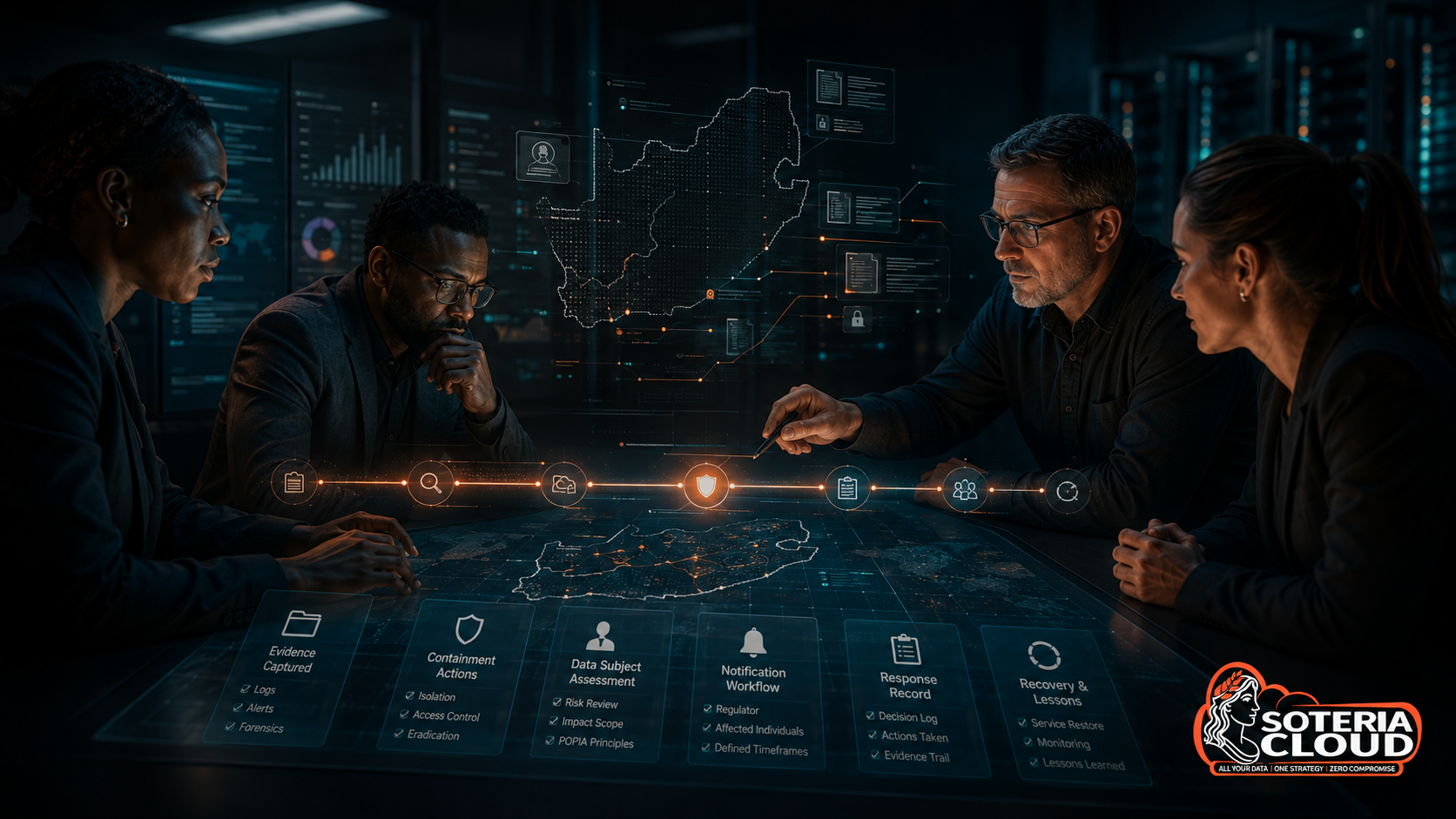
Compliance becomes real at 02:00 when an alert suggests that personal information may have been accessed. The client needs to contain the event, establish what happened, protect affected people, restore operations and decide how to notify the Information Regulator. If roles and evidence sources have not been defined beforehand, valuable time is lost.
The South African Information Regulator’s 2025 fact sheet on security compromises makes the obligation unusually clear: POPIA provides no low-risk threshold below which a compromise may be ignored. Security compromises must be reported, and notification should occur as soon as the responsible party is reasonably sure that one has occurred. The investigation does not have to be complete first.
That creates a valuable advisory opportunity for MSPs—but it also requires a clear line between technical support and the client’s legal accountability.
The responsible party remains responsible
Under POPIA, the client will usually be the responsible party and the MSP an operator processing information on its behalf. If the operator becomes aware of a compromise, it must notify the responsible party. The Information Officer or Deputy Information Officer is then central to the organisation’s reporting and data-subject notification process.
An MSP should not present technology as a guarantee of POPIA compliance or make legal decisions for the client. It can, however, provide the controls, records and response discipline that allow the client and its advisers to make informed decisions quickly.
Productise incident readiness before the breach
A POPIA-aligned incident-readiness service can include:
- Asset and data mapping: identify protected workloads, business owners, personal-information locations and critical dependencies.
- Technical safeguards: deploy layered endpoint, email, identity, data-loss prevention, patching and backup controls appropriate to the risk.
- Detection and escalation: define which events are escalated, how severity is assessed and how the Information Officer is reached after hours.
- Evidence preservation: retain relevant alerts, audit trails, logs, backup activity, response actions and timelines.
- Response runbooks: document containment, credential resets, device isolation, recovery, communications and decision ownership.
- Exercises: rehearse a plausible incident so that technical and business teams understand their roles.
The deliverable is not a certificate. It is demonstrable readiness.
Why an integrated platform helps
During a fragmented incident, one technician checks email security, another searches endpoint alerts, someone else inspects backup jobs and the client tries to reconstruct the story from tickets. Every hand-off introduces delay and uncertainty.
Through Soteria Cloud and Acronis Cyber Protect Cloud, MSPs can bring backup, EDR/XDR, MDR, email security, DLP, security awareness and RMM into one operational ecosystem. This helps create a more coherent view of prevention, detection, response and recovery. It also supports clearer service ownership: what the MSP monitors, what it manages and what still requires the client’s decision.
Evidence matters as much as action
After a compromise, clients will need a reliable chronology. When was the first indicator observed? Which identities, devices and information were affected? What containment occurred? Which backups were available? When were systems restored? Which uncertainties remain?
Structured incident tickets, preserved alerts and documented operator-to-responsible-party escalation give the Information Officer and legal advisers a stronger factual base. They also enable the post-incident review required to close control gaps.
Make readiness a recurring conversation
POPIA readiness should not be a one-off project. Environments change: staff join, SaaS applications are adopted, new data sets are created and backup scope drifts. A quarterly review can track new workloads, unresolved exceptions, test restores, phishing resilience, patch posture and runbook changes.
Soteria Cloud supports South African partners with locally hosted Acronis cloud services, Rand-based commercial models and fully managed, co-managed or self-managed delivery options. The MSP keeps the client relationship while gaining a broader platform and local support structure.
POPIA reporting obligations sit with the responsible party, but good technical readiness is built long before the report is filed. MSPs that can combine safeguards, evidence and tested recovery give clients something far more useful than compliance language: the ability to respond under pressure.
This article is general information and not legal advice. Clients should obtain advice from their Information Officer and qualified legal or privacy professionals for their circumstances.
Build a practical incident-readiness service for your clients. Explore our partner programme or talk to Soteria Cloud.