
Most MSPs believe they can recover their customers’ environments.
Backup dashboards are healthy. Storage is available. Backup jobs complete successfully. Everything appears operationally safe.
This creates confidence.
But confidence is not the same as certainty.
The difference between backup and recoverability only becomes visible when recovery is required.
By then, assumptions are replaced by outcomes.
Backup confirms storage. Recoverability confirms operation.
Backup systems are designed to ensure that data is copied and stored elsewhere. They answer a technical question:
Does the data exist somewhere else?
This is important. But it is only one part of resilience.
Businesses do not operate on stored data. They operate on systems, identities, applications, and infrastructure working together.
Recoverability answers a different question:
Can the business function again?
Restoring data is not the same as restoring operations.
A business is only recovered when users can work, systems can authenticate, applications can connect, and services can operate normally.
This requires far more than successful backups.
Recovery is an operational process
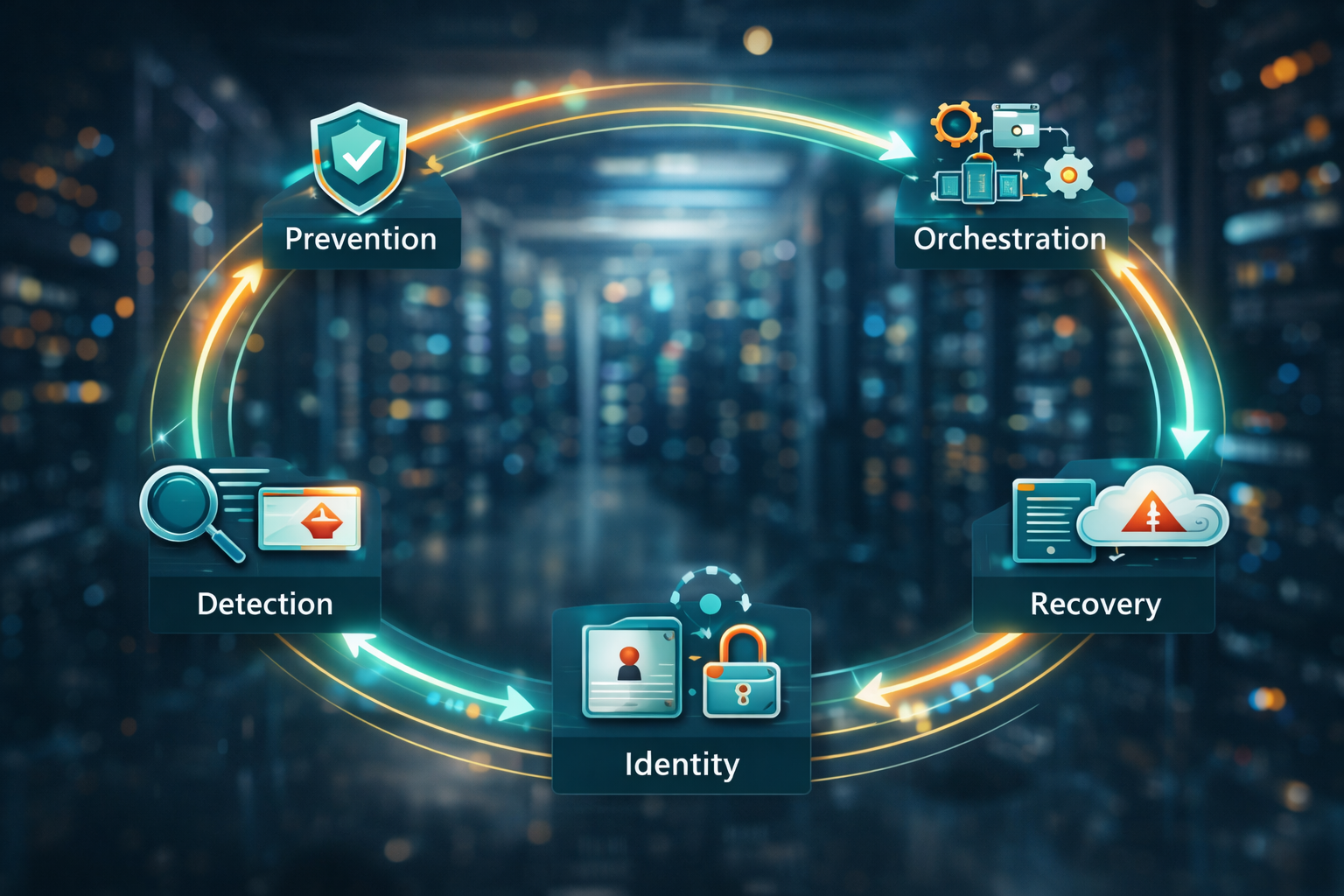
Recovery involves multiple operational layers functioning correctly at the same time.
Infrastructure must be available.
Authentication systems must function.
Network paths must resolve correctly.
Applications must reconnect to their dependencies.
Management systems must remain accessible.
Recovery must also occur in the correct sequence. Dependencies must be restored in order. Identity systems often must be operational before applications can function. Networks must exist before systems can communicate.
Backup does not validate these operational dependencies.
Backup only confirms that data exists.
Recoverability confirms that the operational environment can be restored.
Complexity is the most common point of failure
Most MSP environments evolve over time. New tools are added to solve specific problems. Backup platforms, security tools, monitoring systems, and management layers are introduced gradually.
Each tool improves capability.
Each tool also introduces new dependencies.
Recovery becomes a coordinated process across multiple systems.
Fragmented environments increase recovery complexity. Manual recovery steps increase operational risk. Limited visibility increases uncertainty.
Recovery failure rarely occurs because data does not exist.
It occurs because operational dependencies do not align during recovery.
The more complex the environment, the greater the uncertainty during recovery.
Backup success does not prove recoverability
Backup dashboards provide technical validation. They confirm that backup jobs have completed successfully and data is stored.
But they do not confirm that recovery will succeed under real-world conditions.
Recovery pathways remain theoretical until exercised under pressure.
Many MSPs assume recoverability based on backup success alone.
This assumption introduces hidden operational risk.
Recoverability is not proven by storing data.
It is proven by restoring operations.
The operational responsibility of the MSP
Customers do not measure resilience based on backup success.
They measure resilience based on recovery outcomes.
They measure how quickly their business can operate again. They measure how long systems remain unavailable. They measure whether disruption is temporary or prolonged.
Backup is invisible to customers.
Recovery is not.
Recovery determines whether a disruption becomes an inconvenience or a business crisis.
MSPs who design environments with recoverability as a primary objective reduce operational uncertainty for their customers and themselves.
They move from storing data to restoring operational continuity.
Recoverability must be deliberately designed
True resilience is not achieved by accumulating tools. It is achieved by designing environments where recovery is predictable, coordinated, and operationally viable.
This requires reducing fragmentation, improving visibility, and ensuring recovery pathways are achievable under real-world conditions.
Recoverability is an operational capability.
It must be designed.
It must be supported.
It must be achievable when needed.
Backup creates preparation.
Recoverability creates certainty.